


Improper storage conditions, such as excessive humidity, prolonged heat exposure, and unsuitable stacking methods, may affect the dimensional stability and physical condition of thermal break strips. Understanding these risks helps prevent unnecessary installation difficulties and maintain reliable product performance.
Why Do Storage Conditions Matter for Thermal Break Strips?
Most high-performance thermal break strips are manufactured using PA66 reinforced with glass fiber (PA66 GF25). This material combines mechanical strength, thermal resistance, and dimensional stability, making it suitable for thermally broken aluminum profiles.
However, PA66 is hygroscopic, meaning it naturally absorbs moisture from its surrounding environment. Changes in moisture content can influence the material's dimensions and mechanical properties.
Although glass fiber reinforcement improves structural stability, it does not completely eliminate the effects of environmental exposure. Therefore, appropriate storage conditions remain essential for preserving product consistency between manufacturing and installation.
How Can Improper Storage Affect Thermal Break Strips?
Different storage conditions can affect thermal break strips in different ways. Some changes may be temporary, while prolonged or severe exposure can result in physical damage or material deterioration.
The following table summarizes common storage problems and their potential consequences.
| Storage Issue | Potential Effect on Thermal Break Strips |
| Excessive humidity | Moisture absorption and dimensional changes |
| Prolonged heat exposure | Possible distortion or accelerated material aging |
| Direct sunlight | Increased risk of surface aging from UV exposure |
| Improper stacking | Bending, deformation, or localized damage |
| Poor storage protection | Scratches, contamination, or accidental damage |
Moisture Absorption and Dimensional Stability
Moisture absorption is particularly important for polyamide thermal barrier strips. When exposed to changing humidity levels, PA66 may absorb or release moisture, resulting in dimensional variations.
These changes do not necessarily indicate material failure. However, they can affect dimensional consistency when strips must fit precisely into aluminum profiles.
Physical Deformation and Surface Damage
Improper stacking can place uneven pressure on thermal break strips, potentially causing bending or localized deformation. Similarly, prolonged exposure to unsuitable temperatures may increase the risk of dimensional distortion.
Surface scratches and contamination caused by poor handling can also complicate subsequent processing and inspection.
What Problems Can Poor Storage Cause During Installation?
The consequences of improper storage often become more noticeable during aluminum profile assembly.
Thermal break strips must fit accurately into designated profile grooves to support reliable mechanical engagement. If their dimensions or physical condition have changed significantly during storage, installation may become more difficult.
For example, a thermal break strip that has become noticeably bent due to uneven stacking may not feed smoothly into an aluminum profile, even if its original dimensions met manufacturing specifications.
Dimensional inconsistencies may also require additional inspection before assembly. In severe cases, damaged strips may need to be replaced to avoid compromising the finished thermal break system.
This demonstrates why storage management should be considered part of the overall quality control process rather than a separate logistical concern.
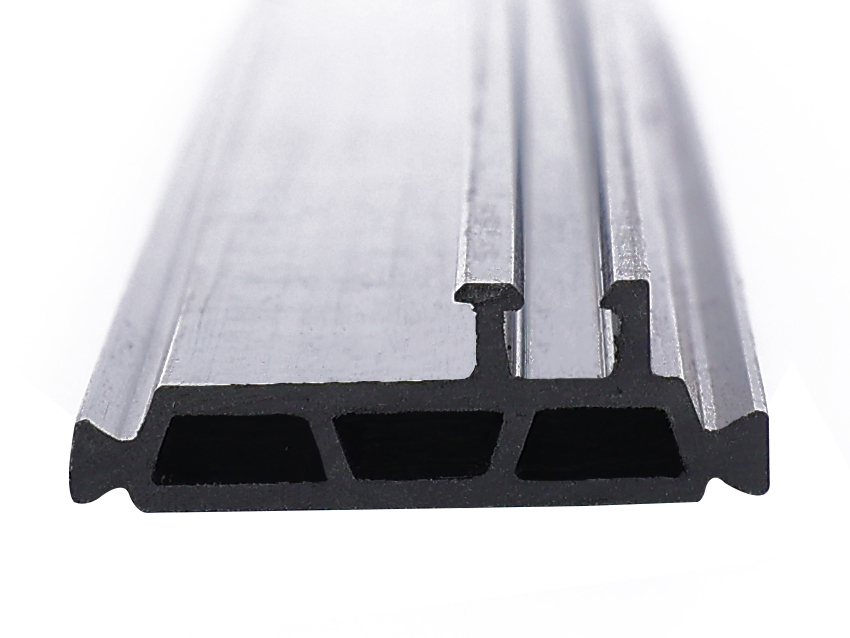
How Should Thermal Break Strips Be Stored Properly?
Maintaining suitable storage conditions helps protect thermal break strips from unnecessary environmental exposure and physical damage.
Several practical measures can reduce common storage-related risks:
-
▶ Maintain a suitable indoor environment: Store thermal break strips in a clean, dry, well-ventilated area, avoiding excessive humidity and temperature fluctuations.
-
▶ Avoid direct sunlight: Protect products from prolonged UV exposure and nearby heat sources.
-
▶ Use appropriate stacking methods: Keep strips properly supported and avoid excessive pressure that could cause bending or deformation.
-
▶ Preserve protective packaging: Retain suitable packaging until the products are required for processing or installation.
-
▶ Follow manufacturer recommendations: Observe any specified storage, handling, and material-conditioning requirements.
Before installation, checking the strips for visible deformation, surface damage, and dimensional consistency can help identify potential problems early.
Specific temperature and humidity requirements should follow the manufacturer's technical guidance rather than relying on universal storage limits.
Why Does Proper Storage Help Maintain Long-Term Product Quality?
Reliable thermal break performance begins with material selection and manufacturing quality, but it also depends on appropriate handling throughout the product's journey.
Bergman specializes in thermal barrier materials for aluminum window, door, and curtain wall applications. Its PA66 thermal barrier strips are designed to provide mechanical stability and effective thermal separation within aluminum profile systems.
When combined with suitable storage practices, properly manufactured thermal break strips can maintain the dimensional consistency and physical condition required for subsequent processing.
For manufacturers working with precision aluminum profiles, protecting materials before installation is a practical way to reduce avoidable processing problems and support consistent assembly quality.
Ultimately, proper storage is more than a maintenance precaution. It is an important step in preserving thermal break strip quality from production to final installation.