


Why Testing Matters for Thermal Barrier Strips
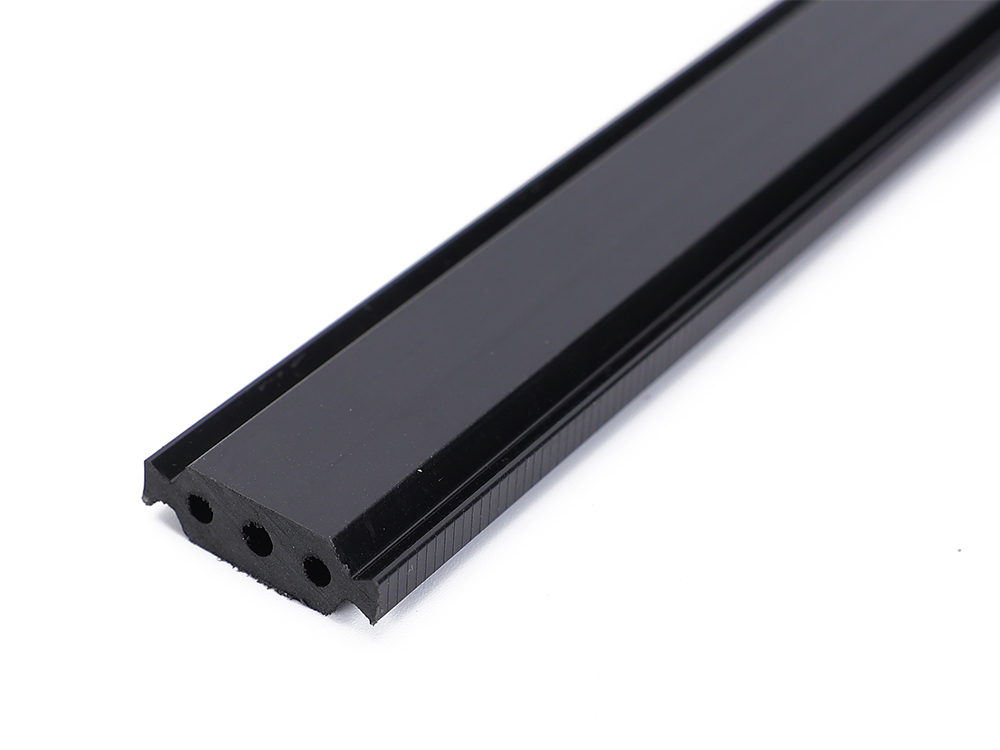
A thermal break strip sits between aluminum profiles to reduce direct heat transfer through the highly conductive metal. While its insulating function is important, the strip must also maintain a secure connection between profile sections.
A high-quality product therefore needs to balance thermal insulation with mechanical and dimensional performance. Poor-quality strips may shrink, deform, absorb excessive moisture, or lose strength under temperature changes, potentially affecting the performance of the entire window or curtain wall system.
Testing provides objective data that helps manufacturers verify whether a Thermal Barrier Strip meets its intended application requirements.
The Seven Core Tests
1Material Composition Testing
Material composition is the starting point for evaluating a thermal barrier strip. Polyamide, particularly glass-fiber-reinforced PA66, is widely used because it combines relatively low thermal conductivity with good mechanical performance.
Testing can verify the polymer type, glass fiber content, and consistency of the material formulation. Glass fiber reinforcement is particularly important because it improves stiffness, tensile strength, and dimensional stability.
For B2B buyers, consistent material composition is just as important as the nominal specification. A supplier should be able to maintain stable formulations across production batches and provide relevant quality documentation when required.
2Dimensional Accuracy Testing
Thermal break strips must fit precisely into aluminum profiles. Even small dimensional variations can create difficulties during assembly or affect the connection between the polyamide strip and aluminum profile.
Dimensional testing generally evaluates parameters such as width, thickness, length, and tolerances. More importantly, manufacturers should consider whether these dimensions remain stable after exposure to heat and moisture.
Good Thermal Barrier Strips should maintain predictable dimensions throughout processing and service. This supports easier profile assembly and helps manufacturers achieve consistent production results.
3Tensile and Mechanical Strength Tests
Although thermal insulation is the primary purpose of a thermal break strip, mechanical strength cannot be overlooked.
Tensile strength, elongation, flexural properties, and other mechanical characteristics can help determine whether a strip can withstand forces encountered during profile processing, assembly, transportation, and long-term use.
Glass-fiber-reinforced polyamide is particularly valuable in this application because the reinforcement improves rigidity and load-bearing capability. A strip with insufficient mechanical strength may deform or fail, compromising the integrity of the thermal break system.
For window and curtain wall manufacturers, mechanical test results are therefore an important indicator of whether a product is suitable for demanding applications.
4Thermal Performance Testing
Thermal performance is at the heart of a thermal break system. Testing may evaluate the thermal conductivity or thermal resistance of the strip material.
Lower thermal conductivity generally indicates that the material offers greater resistance to heat transfer. However, buyers should avoid evaluating a thermal barrier strip solely from its material thermal conductivity.
The final thermal performance also depends on the geometry of the aluminum profile, strip design, installation method, and overall window or facade construction. Material-level testing evaluates the strip itself, while system-level testing can help determine the thermal transmittance of the complete assembly.
This distinction is particularly important when selecting Thermal Barrier Strips for energy-efficient building systems.
5Water Absorption Testing
Polyamide materials can absorb moisture, making water absorption an important consideration for long-term applications.
Water absorption testing evaluates how much moisture a material takes in under specified conditions and whether this moisture affects its properties. Excessive moisture uptake can influence dimensions, mechanical strength, and dimensional stability.
The goal is not simply to find a material with the lowest possible water absorption. More importantly, the thermal barrier strip should maintain acceptable performance after moisture exposure.
This is especially relevant for curtain walls, exterior windows, and doors that may experience changing humidity and weather conditions throughout their service life.
6Heat Aging and Thermal Stability Tests
Thermal break strips can be exposed to elevated temperatures, particularly in exterior aluminum systems exposed to strong sunlight. Heat aging tests help determine whether the material can retain its properties after prolonged thermal exposure.
Testing may examine changes in mechanical strength, dimensions, appearance, and other physical properties following exposure to elevated temperatures.
A reliable Thermal Barrier Strip should not only perform well when newly manufactured. It should also retain sufficient stability as temperatures repeatedly rise and fall during actual service.
7Environmental Aging and Durability Testing
Long-term building applications require more than short-term laboratory performance. Thermal barrier strips may experience humidity, temperature fluctuations, ultraviolet exposure, and other environmental factors.
Depending on the application and applicable standards, durability evaluation may include:
- UV and weathering exposure
- Temperature and humidity cycling
- Chemical resistance
- Long-term aging and property retention
These tests help manufacturers understand how the material behaves under conditions that are closer to real-world use. For B2B buyers, durability testing can provide valuable insight into potential maintenance requirements and expected product reliability.
How Should Buyers Evaluate Test Reports?
A test report should be evaluated as a complete set of performance data rather than focusing on one impressive number.
| Test | What It Evaluates | Why It Matters |
|---|---|---|
| Material composition | Polymer and reinforcement consistency | Supports stable product quality |
| Dimensional testing | Size and tolerances | Ensures profile compatibility |
| Mechanical testing | Strength and stiffness | Supports structural reliability |
| Thermal testing | Thermal conductivity and resistance | Reduces heat transfer |
| Water absorption | Moisture-related changes | Improves dimensional stability |
| Heat aging | Performance after thermal exposure | Supports long-term use |
| Environmental testing | Weather and aging resistance | Evaluates durability |
Buyers should also consider whether the supplier has effective quality control throughout raw material selection, extrusion, inspection, and final delivery. Consistent manufacturing is essential because a technically good product is only valuable if the same performance can be maintained from batch to batch.
Choosing a Reliable Manufacturer
For B2B buyers, supplier capability can be just as important as product specifications. A manufacturer with its own R&D, production, sales, and service capabilities is generally better positioned to provide consistent technical support and respond to application requirements.
Huzhou Bergman Advanced Materials was established in December 2010 and is a national high-tech enterprise and provincial-level science and technology enterprise integrating R&D, production, sales, and service. The company covers 32,000 square meters and successfully listed on the New Third Board in February 2015.
Bergman focuses on high-performance polymer materials and produces insulation strips and insulation glue for building aluminum profiles, alongside adhesives and sealants for electronics, filtration, packaging, and textile applications. Its experience in polymer materials provides a solid manufacturing foundation for customers looking for reliable Thermal Barrier Strips for aluminum window, door, and facade systems.
For manufacturers purchasing thermal break components in volume, working with a supplier capable of supporting both product quality and technical requirements can help reduce production risks while improving the consistency of finished systems.
So, what tests determine Thermal Break Strip quality? No single test can provide the complete answer. Material composition, dimensional accuracy, mechanical strength, thermal performance, water absorption, heat aging, and environmental durability should all be considered together.
For B2B buyers, the best approach is to evaluate both the test data and the manufacturer's production capabilities. A well-tested thermal barrier strip, supported by consistent manufacturing and technical expertise, can provide a more dependable foundation for energy-efficient aluminum windows, doors, and curtain wall systems.