


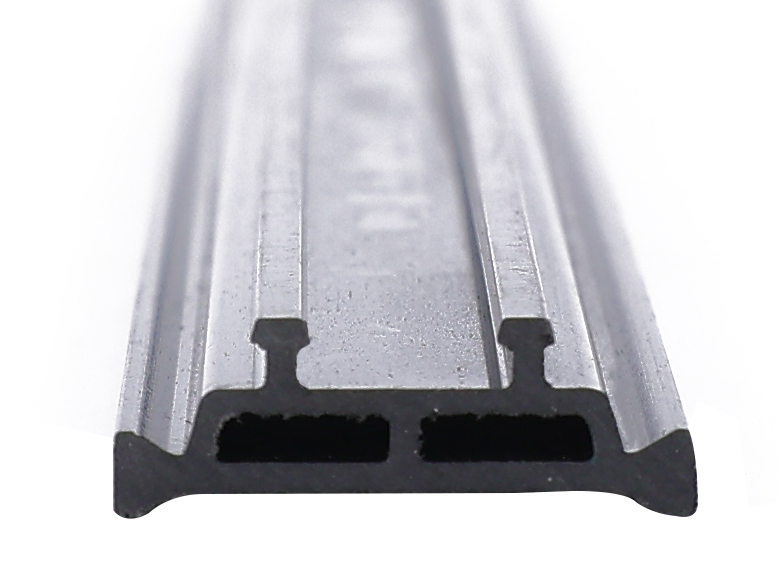
Thermal Break Strip is an important component in thermally insulated aluminum windows, doors, curtain walls, and facade systems. By separating the interior and exterior aluminum sections, it helps reduce direct heat transfer through the metal frame. However, because some building components may be exposed to sunlight during service, the long-term effect of ultraviolet (UV) radiation should also be considered when evaluating thermal break materials.
UV exposure does not normally cause immediate failure. Instead, prolonged radiation can gradually change the polymer structure and surface properties of the material. Research on PA66 has shown that extended UV aging can cause molecular degradation and eventually reduce mechanical performance.
Why Is UV Resistance Important for Thermal Break Strips?
Thermal break strips are commonly manufactured from engineering polymers such as PA66, often reinforced with glass fibers to achieve the required mechanical strength and dimensional stability.
When a thermal break strip is incorporated into an aluminum profile, part of the material may remain relatively protected inside the profile. However, exposed sections can experience sunlight, temperature fluctuations, moisture, and oxygen over long periods.
This means UV resistance should be considered together with other environmental factors rather than treated as an isolated property.
A material with good initial mechanical properties may still require appropriate stabilization and weathering evaluation if it is intended for applications where prolonged outdoor exposure is possible.
How Does UV Radiation Affect PA66 Thermal Break Strips?
UV radiation can initiate photo-oxidative reactions in polymer materials. For PA66, studies have identified molecular chain scission and changes in the material's structure during prolonged UV aging. These changes can eventually contribute to reduced elongation, embrittlement, surface cracking, and deterioration of mechanical properties.
The degradation process can generally be understood in three stages.
STAGE 1 — INITIALLY
Changes may be relatively limited and difficult to identify visually.
STAGE 2 — WITH CONTINUED EXPOSURE
Chemical changes accumulate in the polymer's surface layer.
STAGE 3 — AT A LATER STAGE
Degradation can become more apparent through changes in mechanical behavior and surface morphology.
REFERENCED STUDY
A 2026 study of glass-fiber-reinforced polyamide composites observed surface cracking, matrix embrittlement, and partial fiber-matrix debonding after accelerated UV exposure. The research also found that higher glass-fiber content could help delay UV-related surface degradation, although the exact behavior depends on the material formulation and exposure conditions.
Which Properties Can Be Affected by UV Exposure?
The most important concern is not simply whether the color of a Thermal Barrier Strip changes. For structural applications, the more relevant question is whether prolonged exposure changes the properties required for the thermal break system to remain mechanically stable.
Potentially affected properties include:
| Property | Possible Effect of Prolonged UV Exposure |
|---|---|
| Tensile strength | May decrease as polymer degradation progresses |
| Elongation | Can decline as the material becomes more brittle |
| Impact resistance | May decrease with surface embrittlement |
| Surface integrity | Cracking or roughening may develop |
| Fiber-matrix bonding | Can be affected near degraded surface regions |
| Dimensional stability | May be affected indirectly by long-term material degradation |
The extent of these changes depends on factors such as polymer formulation, glass-fiber reinforcement, stabilizers, exposure intensity, temperature, moisture, and exposure duration. Therefore, a specific service-life value should not be assumed from UV exposure time alone.
Does Glass Fiber Improve UV Durability?
Glass fiber plays an important role in the mechanical performance of reinforced PA66, but it should not be treated as a complete solution to UV degradation.
Research on short-glass-fiber-reinforced polyamide composites indicates that higher glass-fiber content can reduce UV penetration and delay some forms of surface degradation.
At the same time, the polymer matrix surrounding the fibers remains important. UV radiation primarily interacts with the polymer surface, so the formulation, stabilization system, fiber distribution, and fiber-matrix interface all contribute to the final weathering performance.
This is why glass fiber content alone should not be used as the only indicator of UV resistance when evaluating a Thermal Break Strip.
How Can UV Resistance Be Evaluated?
For manufacturers and buyers, accelerated weathering tests can provide useful information about how a material responds to controlled UV exposure.
A practical evaluation can compare unaged and aged specimens for changes in mechanical and physical properties. Depending on the application, the evaluation may include tensile strength, elongation, impact performance, dimensional changes, surface appearance, and microscopic examination.
However, accelerated testing should be interpreted carefully. Laboratory exposure conditions do not perfectly reproduce every outdoor environment. Factors such as solar intensity, temperature, humidity, condensation, and exposure orientation can influence real-world aging.
For this reason, test results should be considered alongside the material specification, product design, installation conditions, and intended service environment.
How Can Manufacturers Improve Thermal Break Strip UV Resistance?
UV durability begins with material selection and formulation rather than being addressed only after production.
For a PA66 Thermal Break Strip, manufacturers may consider UV stabilizing technologies, appropriate glass-fiber reinforcement, controlled processing conditions, and consistent raw-material quality. Production control is also important because variations in polymer composition, fiber distribution, moisture content, or processing conditions can affect the final properties of the strip.
At the system level, profile design can also reduce unnecessary direct exposure of the polymer component. Where the thermal break is largely enclosed within the aluminum profile, the actual UV exposure may be substantially different from that of a polymer component installed fully outdoors.
Therefore, the correct approach is to evaluate the material, profile design, and exposure conditions together.
What Should Buyers Check Before Choosing a Thermal Break Strip?
For projects where long-term outdoor exposure is a concern, buyers should look beyond basic dimensions and tensile strength. Useful technical information may include the polymer type, glass-fiber reinforcement, relevant material specifications, weathering or UV-aging test data, dimensional tolerances, and mechanical-property retention after aging.
It is also important to distinguish between a material's initial performance and its performance after environmental aging. A thermal break strip intended for long-term use should be evaluated according to the actual requirements of the window, door, curtain wall, or facade system.
UV Resistance Is Part of Long-Term Thermal Break Performance
UV exposure is one of several environmental factors that can influence the long-term durability of polymer-based Thermal Barrier Strips. For PA66 materials, prolonged UV radiation can contribute to molecular degradation, surface damage, embrittlement, and changes in mechanical properties.
However, UV resistance should not be judged by a single specification. Material formulation, glass-fiber reinforcement, stabilization, manufacturing consistency, profile design, and actual exposure conditions all need to be considered.
For aluminum window and door manufacturers, curtain wall fabricators, and other system designers, evaluating both initial properties and retained performance after accelerated weathering can provide a more realistic basis for assessing Thermal Break Strip durability.