


The quality of a thermal break strip is determined long before the finished product reaches a window or door manufacturer. For PA66 thermal break strips, performance depends on the consistency of raw materials, glass fiber distribution, extrusion conditions, dimensional control, cooling, and quality inspection. Even small variations during manufacturing can affect mechanical strength, dimensional stability, fitting accuracy, and long-term durability.
For buyers of thermal break strips, understanding these manufacturing factors can make it easier to evaluate supplier capabilities and maintain consistent performance across production batches.
1. Raw Material Selection and Consistency
Raw material quality provides the foundation for thermal break strip performance. PA66 is commonly used for thermal break applications because it combines mechanical strength, heat resistance, and dimensional stability. However, simply specifying PA66 does not guarantee consistent product quality.
The grade and consistency of the PA66 resin can influence processing behavior and the mechanical properties of the finished strip. Variations between raw material batches may affect extrusion stability, surface quality, and dimensional accuracy.
Glass fiber is another important component in reinforced PA66 thermal break strips. Its content, quality, and compatibility with the polymer matrix must be controlled carefully. The right formulation should provide the required balance between strength, stiffness, thermal performance, and dimensional stability for the intended aluminum profile system.
2. Glass Fiber Distribution During Processing
Glass fiber reinforcement can significantly improve the mechanical performance of PA66 thermal break strips, but the distribution of the fibers throughout the polymer matrix is equally important.
Uneven glass fiber distribution can create localized differences in strength and shrinkage. Areas with insufficient reinforcement may have lower mechanical performance, while excessive or poorly dispersed fibers can affect processing consistency and surface quality.
Manufacturing conditions such as material mixing, compounding, extrusion temperature, screw configuration, and processing speed can all influence fiber dispersion. Consistent processing helps create a more uniform material structure throughout the profile.
This is particularly important for thermal break strips used in aluminum windows, doors, and curtain wall systems, where the strip must maintain reliable mechanical engagement with the surrounding aluminum profile.
3. Extrusion Temperature Control
Extrusion is one of the most important manufacturing stages for thermal break strips. PA66 must be processed within an appropriate temperature range to achieve stable material flow and consistent profile formation.
If the processing temperature is too high, prolonged exposure to excessive heat may affect the polymer and lead to changes in material properties. If the temperature is too low or fluctuates significantly, the material may not flow consistently through the extrusion die.
Stable temperature control across the extrusion system helps manufacturers maintain consistent profile geometry, surface quality, and material performance. Temperature monitoring should therefore be part of routine process control rather than an adjustment made only when production problems occur.
4. Extrusion Speed and Processing Stability
Extrusion speed also affects the consistency of a thermal break strip. Changes in production speed can influence material residence time, pressure inside the extrusion system, cooling conditions, and final profile dimensions.
An unstable extrusion process may result in variations in cross-sectional geometry or surface appearance. For profiles that must fit precisely into aluminum systems, even relatively small dimensional changes can create problems during subsequent assembly.
Manufacturers therefore need to balance production efficiency with process stability. Consistent extrusion parameters help reduce variation between production runs and support more predictable product performance.
5. Die Design and Dimensional Accuracy
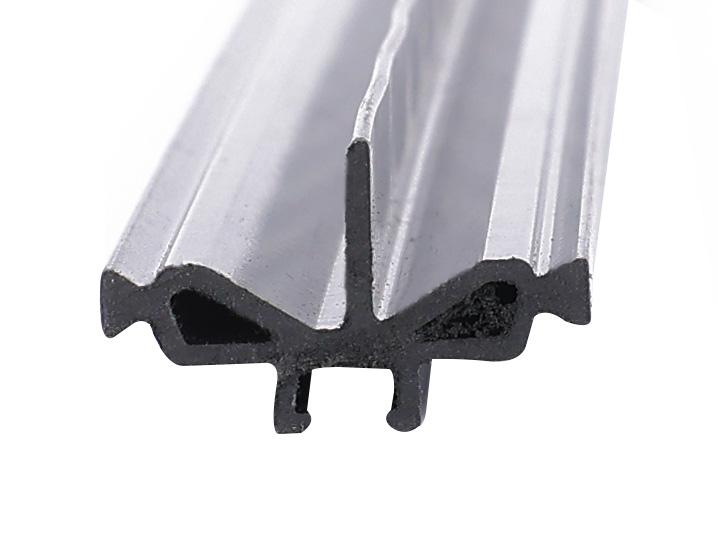
The extrusion die determines the basic geometry of the thermal break strip. Because these strips are designed to fit specific aluminum profiles, dimensional accuracy is a critical quality factor.
The die must provide a stable and uniform material flow so that the finished profile maintains the required width, thickness, shape, and tolerances. Poor die design or uneven material flow can result in profile deformation, inconsistent wall thickness, or dimensional deviations.
Dimensional accuracy is particularly important during mechanical assembly. A strip that does not match the aluminum profile correctly may affect fitting, locking, and the overall stability of the thermal break system.
For B2B buyers, dimensional tolerances should therefore be considered alongside material specifications when evaluating a thermal break strip supplier.
6. Cooling and Dimensional Stability
After extrusion, the hot profile must be cooled under controlled conditions. Cooling is not simply a step for reducing the product temperature; it also influences the final dimensions and shape of the strip.
Uneven or excessively rapid cooling can contribute to internal stress, deformation, or dimensional variation. Since PA66-based materials can experience changes in dimensions as they cool and stabilize, the cooling process needs to be consistent across the profile.
Proper cooling control helps manufacturers achieve better dimensional stability and reduce the risk of shrinkage or deformation after production.
This is especially relevant when thermal break strips are used in precision aluminum systems. A product that meets dimensional requirements immediately after extrusion but changes significantly during subsequent storage or processing may still create assembly problems.
7. Moisture Control Before and During Processing
Moisture management is another important consideration when manufacturing PA66 thermal break strips. Polyamide materials can absorb moisture from the surrounding environment, so raw material handling and storage conditions need to be controlled.
Excessive moisture in the material before processing can affect extrusion behavior and the consistency of the finished product. For this reason, manufacturers commonly use appropriate material storage and drying procedures before processing PA66.
Moisture control should also extend beyond the extrusion stage. Proper storage and packaging can help protect finished thermal break strips from environmental exposure before they are delivered to customers.
8. Surface Quality and Profile Consistency
A thermal break strip should maintain a consistent cross-sectional shape and surface condition throughout its length. Visible defects such as scratches, deformation, voids, or irregular surfaces can indicate problems in extrusion, cooling, handling, or material preparation.
Surface appearance alone does not determine whether a thermal break strip will perform properly, but it can provide useful information about manufacturing consistency. More importantly, dimensional and structural consistency must be maintained alongside acceptable surface quality.
For applications involving aluminum windows, doors, and curtain walls, consistent profile geometry helps support reliable assembly and reduces the risk of fitting problems during production.
9. Post-Extrusion Handling and Storage
Manufacturing quality can also be affected after the extrusion process is completed. Thermal break strips may be cut, packaged, stacked, transported, and stored before they are incorporated into an aluminum profile.
Improper handling can cause bending, scratches, deformation, or other physical damage. Excessive stacking pressure or unsuitable storage conditions may also affect the dimensional stability of long profiles.
Packaging should therefore protect the strips from mechanical damage and environmental exposure. Appropriate storage practices are particularly important for customized profiles that may remain in inventory before being processed.
10. In-Process Quality Control
Effective quality control should take place throughout manufacturing rather than relying entirely on final inspection.
A typical control system may monitor different factors at different production stages:
| Manufacturing Stage | Key Quality Control Factors |
| Raw material preparation | Material consistency, grade, and moisture |
| Compounding | Glass fiber content and dispersion |
| Extrusion | Temperature, pressure, and processing stability |
| Profile forming | Cross-sectional dimensions and tolerances |
| Cooling | Shape retention and dimensional stability |
| Final inspection | Appearance, dimensions, and required performance |
This approach helps manufacturers identify process deviations earlier. It can also improve batch-to-batch consistency, which is particularly important for customers producing large quantities of aluminum windows, doors, and curtain wall systems.
Final testing remains important, but a strong manufacturing process reduces the likelihood that defects will reach the final inspection stage in the first place.
Which Manufacturing Factors Matter Most?
No single manufacturing parameter determines the overall quality of a thermal break strip. Instead, product performance results from the interaction of material selection, reinforcement, extrusion, dimensional control, cooling, and quality management.
For example, a high-quality PA66 resin cannot compensate for poor glass fiber dispersion, just as accurate extrusion cannot fully compensate for unsuitable raw materials. Consistency across the entire production process is what allows manufacturers to produce thermal break strips with predictable mechanical and dimensional properties.
For this reason, buyers should look beyond a supplier's product specifications and consider how consistently the manufacturer controls its production process.
Choosing a Thermal Break Strip Manufacturer
When evaluating thermal break strip suppliers, buyers should consider both the product itself and the manufacturer's ability to maintain consistent production quality. Material specifications, dimensional tolerances, quality control procedures, testing documentation, and batch consistency can provide useful information about manufacturing capabilities.
For customized thermal break strips, communication between the manufacturer and aluminum profile producer is also important. The strip needs to match the required profile geometry and application conditions, while the manufacturing process must be capable of maintaining the specified dimensions over repeated production runs.
A reliable thermal break strip is ultimately the result of controlled materials, stable processing, accurate extrusion, and systematic quality management. Understanding these manufacturing factors can help buyers make more informed decisions and reduce quality risks when sourcing thermal break strips for aluminum windows, doors, and building envelope applications.