


BUILDING SCIENCE · THERMAL PERFORMANCE
How Thermal Break Design Impacts Window Airtightness
Modern aluminum window systems are expected to do far more than simply provide natural light and ventilation. Today's buildings demand high levels of energy efficiency, indoor comfort, moisture control, and acoustic performance. One factor that strongly influences all of these characteristics is window airtightness. While sealing gaskets and installation quality are often discussed, the design of the thermal break system itself also plays a major role in determining how airtight a window remains over time.
What Is Window Airtightness?
Window airtightness refers to the ability of a window system to resist uncontrolled air leakage between indoor and outdoor environments. Poor airtightness allows outside air to pass through gaps in the frame or sash assembly, leading to:
- ▶ Drafts near windows
- ▶ Increased heating and cooling costs
- ▶ Dust infiltration
- ▶ Moisture penetration
- ▶ Reduced indoor comfort
In aluminum systems, maintaining airtightness can be especially challenging because aluminum naturally expands and contracts with temperature changes. Without proper thermal separation, repeated thermal movement can gradually affect sealing performance.
How Thermal Break Strips Influence Airtightness
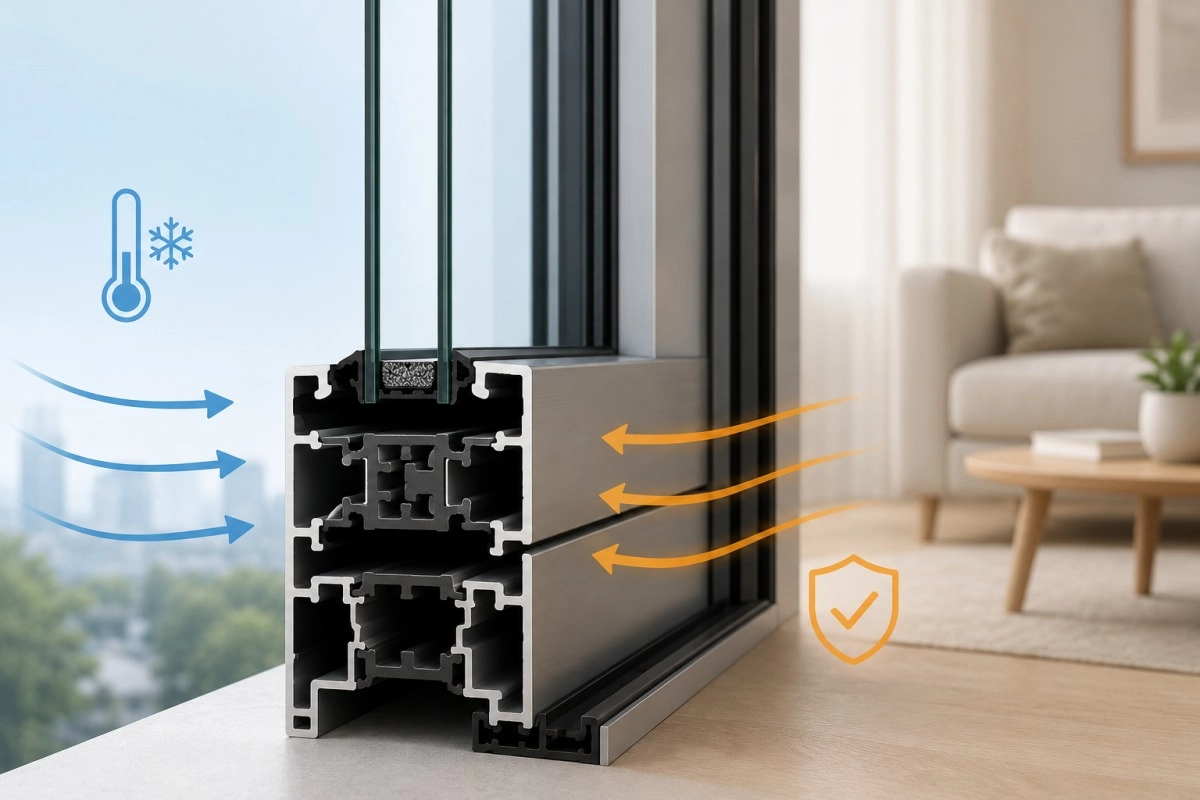
Thermal Break Strips are typically installed between the interior and exterior aluminum profiles to interrupt thermal bridging. However, they also influence the structural stability of the frame itself.
A well-designed thermal break system helps:
- ▶ Reduce thermal expansion differences
- ▶ Maintain alignment between frame components
- ▶ Stabilize gasket compression
- ▶ Prevent long-term deformation
When the thermal break material lacks dimensional stability, the frame may gradually shift during temperature cycling. Even small changes in alignment can create micro-gaps around seals, allowing air leakage to develop over time.
High-quality thermal break systems made from reinforced PA66 polyamide are commonly preferred because they combine insulation performance with strong mechanical stability.
Why Material Stability Matters
Not all thermal break materials perform equally under environmental stress. Inferior materials may soften, deform, or shrink after long-term exposure to heat, moisture, and UV radiation.
Airtightness problems caused by inferior materials
▶ Uneven sealing pressure
▶ Loose frame connections
▶ Reduced gasket contact
▶ Air infiltration around corners or joints
In contrast, reinforced polyamide thermal breaks maintain stable dimensions under temperature fluctuations. Because their thermal expansion behavior is closer to aluminum than ordinary plastics, stress between components is reduced.
The result is a more stable window assembly with better long-term sealing performance.
Relationship Between Thermal Break Design and Airtight Performance
The table below shows how different aspects of thermal break design can influence window airtightness.
| Thermal Break Design Factor | Impact on Airtightness |
|---|---|
| Material Stability | Maintains consistent frame geometry |
| Precision Manufacturing | Reduces assembly gaps |
| Proper Width Selection | Improves thermal separation and seal consistency |
| Glass Fiber Reinforcement | Increases rigidity under load |
| Resistance to Thermal Expansion | Minimizes frame movement |
| Long-Term Durability | Prevents aging-related air leakage |
Even small improvements in these areas can significantly affect the long-term performance of a window system.
Airtightness and Energy Efficiency Are Closely Connected
Poor airtightness directly affects building energy consumption. When outside air continuously enters the room, HVAC systems must work harder to maintain stable indoor temperatures.
Seasonal energy impact
▶ In winter, cold air leakage increases heating demand
▶ In summer, warm outdoor air raises cooling loads
▶ Humid air infiltration can increase condensation risk
A stable thermal break design helps preserve both insulation performance and airtight sealing. This combination is essential in modern energy-efficient buildings, especially in regions with large seasonal temperature differences.
Real-World User Experience
In actual residential use, airtightness problems are often noticed before occupants understand the technical cause.
A homeowner may experience:
▶ Cold drafts near the window during winter
▶ Dust accumulation around frame edges
▶ Increased outside noise despite closed windows
▶ Uneven room temperatures
At first, these problems are often blamed on installation quality alone. However, in some cases, long-term deformation of low-quality thermal break components contributes to the issue.
When the thermal break loses dimensional stability, gasket pressure becomes inconsistent, and air leakage gradually increases.
This is why engineers increasingly emphasize not only insulation performance but also the structural reliability of the thermal break system itself.
Simple Q&A
Why Precision Manufacturing Is Important
Even high-quality materials can underperform if extrusion precision is poor. Thermal break strips with inconsistent dimensions may create uneven contact surfaces inside the aluminum profile.
Precision manufacturing improves:
▶ Frame alignment
▶ Seal compression consistency
▶ Structural connection stability
▶ Overall airtight reliability
For this reason, many advanced window systems rely on tightly controlled extrusion tolerances and reinforced polyamide materials to achieve both thermal efficiency and airtight performance.
Conclusion
Thermal break design has a direct and often underestimated impact on window airtightness. Beyond reducing heat transfer, Thermal Break Strips help stabilize frame geometry, maintain sealing pressure, and reduce long-term deformation caused by temperature changes.
High-quality thermal break systems made from reinforced polyamide materials contribute to improved airtightness, lower energy consumption, and greater indoor comfort. In modern aluminum windows and curtain wall systems, airtightness is not determined by seals alone — it is closely connected to the structural and thermal stability of the thermal break design itself.