


In modern aluminum window, door, and curtain wall systems, Thermal Break Strips play a critical role in reducing heat transfer, improving energy efficiency, and maintaining structural stability. Because these components are hidden inside aluminum profiles, some buyers focus heavily on lowering initial procurement costs and may choose lower-priced thermal break materials without fully considering long-term performance.
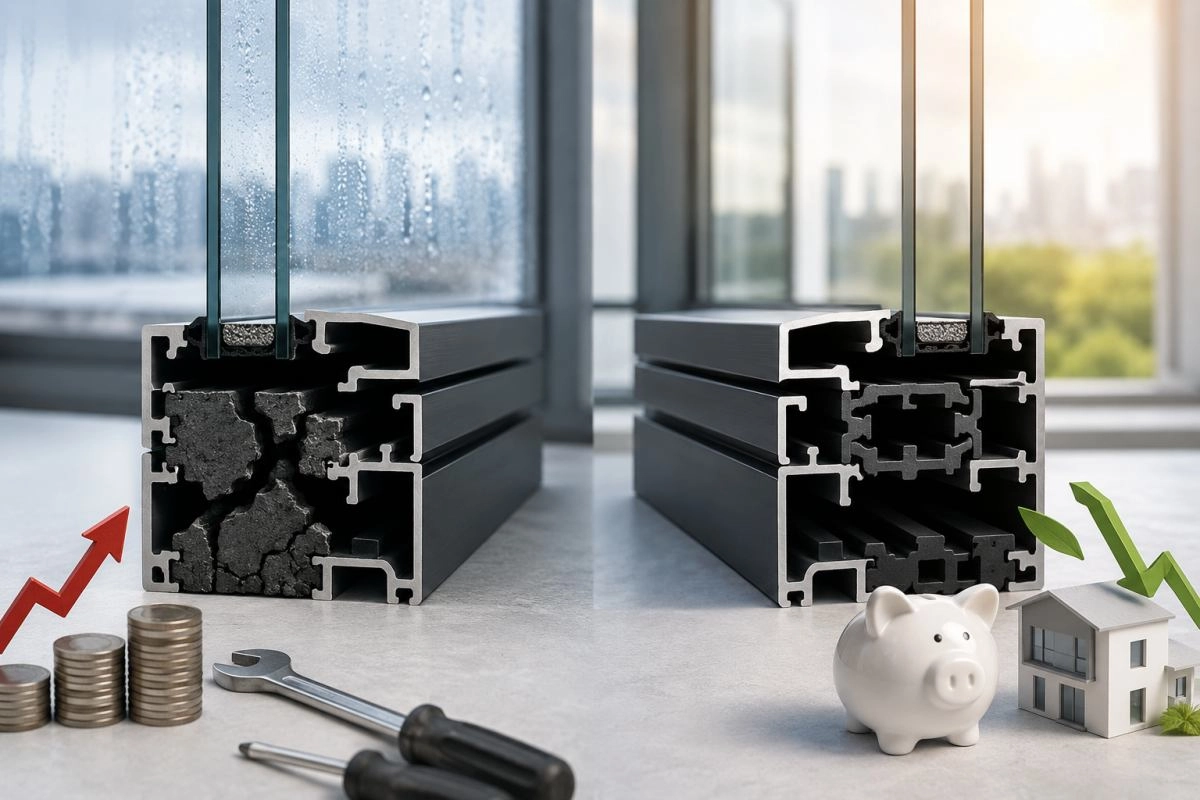
However, in real building applications, cheap thermal break materials often lead to significantly higher maintenance, energy, and replacement costs over time. What appears to be a short-term saving can eventually become a long-term financial burden.
The Purpose of Thermal Break Strips
A Thermal Break Strip is typically installed between the interior and exterior aluminum profiles to interrupt thermal bridging. Since aluminum conducts heat rapidly, the strip acts as an insulating barrier that helps stabilize indoor temperatures and reduce energy loss.
High-quality Thermal Break Strips are commonly manufactured from glass-fiber reinforced PA66 polyamide , a material selected for its combination of:
▶ Low thermal conductivity
▶ High mechanical strength
▶ Dimensional stability
▶ Weather resistance
▶ Long-term durability
When inferior materials are used instead, the entire window or curtain wall system may gradually lose its thermal and structural performance.
Lower Material Costs Often Mean Lower Material Quality
Cheap thermal break materials are often produced using:
▶ Recycled plastics with inconsistent composition
▶ Reduced glass fiber content
▶ Lower-grade nylon substitutes
▶ Poorly controlled extrusion processes
Although these products may initially appear similar to premium strips, the performance gap becomes noticeable after long-term exposure to temperature changes, humidity, UV radiation, and structural stress.
The table below highlights several common differences.
| Performance Factor | High-Quality Thermal Break Strip | Low-Cost Thermal Break Material |
| Base Material | PA66 GF25/GF30 | Recycled or mixed plastics |
| Mechanical Strength | High | Moderate to weak |
| Thermal Stability | Excellent | Prone to deformation |
| Dimensional Precision | Consistent | Uneven tolerances |
| Long-Term Durability | 10+ years stable performance | Early aging or cracking |
| Energy Efficiency | Reliable insulation | Reduced thermal performance |
| Maintenance Risk | Low | Higher repair probability |
Increased Energy Consumption Over Time
One of the biggest hidden costs of poor-quality Thermal Break Strips is reduced energy efficiency. If the strip deforms, shrinks, or loses stability over time, gaps may develop inside the aluminum assembly. These gaps increase heat transfer and reduce insulation performance.
In practical use, building owners may notice:
▶ Higher heating bills during winter
▶ Increased cooling loads in summer
▶ Temperature fluctuations near windows
▶ Drafts around frames
For commercial buildings with large curtain wall systems, even small reductions in insulation efficiency can significantly increase HVAC operating costs year after year.
A building may save a small amount during construction but lose much more through long-term energy consumption.
Structural Problems Can Become Expensive
Thermal Break Strips are not only insulation components—they also contribute to structural connection between aluminum profiles. Weak or poorly manufactured strips may gradually deform under load.
This can lead to:
▶ Reduced sealing performance
▶ Water leakage problems
▶ Air infiltration
▶ Frame movement
▶ Difficulty opening or closing windows and doors
In severe cases, curtain wall assemblies may require partial disassembly for repair. The labor cost of replacing failed thermal break components is often far greater than the original material savings.
A Common Real-World Scenario
In some projects, contractors choose lower-cost Thermal Break Strips to reduce procurement expenses. During the first year, the systems may appear normal. However, after repeated summer and winter temperature cycles, occupants begin noticing condensation around frames and inconsistent indoor temperatures.
Eventually, maintenance teams discover that some strips have slightly warped, affecting sealing pressure and allowing thermal leakage.
At this stage, the problem is no longer just about replacing a strip. Additional costs may include:
▶ Labor for window removal
▶ Seal replacement
▶ Interior finish repairs
▶ Increased energy bills
▶ Occupant complaints
What originally saved a few percent in material cost may create years of operational expense.
Simple Q&A: Questions Buyers Often Ask
Q: Can cheap Thermal Break Strips still meet basic insulation requirements?
In some short-term applications, they may initially provide acceptable insulation. However, long-term stability under environmental stress is often much weaker than high-grade PA66 reinforced materials.
Q: Why do high-quality Thermal Break Strips cost more?
Premium strips use engineered polyamide materials, controlled glass fiber reinforcement, and precision extrusion technology. These factors improve durability, strength, and dimensional consistency.
Q: Is the price difference really important for large projects?
Yes. In large curtain wall systems or commercial buildings, thermal break performance directly affects long-term energy consumption, maintenance frequency, and occupant comfort.
Long-Term Reliability Matters More Than Initial Price
When evaluating Thermal Break Strips, focusing only on upfront price can be misleading. A low-cost product that fails early often becomes more expensive than a premium product with stable long-term performance.
High-quality thermal break materials provide:
▶ Better insulation efficiency
▶ Lower maintenance requirements
▶ Improved condensation resistance
▶ More stable structural performance
▶ Longer service life
For architects, fabricators, and project owners, reliability is often more valuable than minimal initial savings.
Cheap thermal break materials may reduce initial procurement costs, but they often introduce hidden long-term expenses related to energy loss, maintenance, structural instability, and reduced building performance. Since Thermal Break Strips directly affect both insulation efficiency and frame reliability, material quality should never be treated as a minor detail.
In modern aluminum systems, selecting high-quality PA66 reinforced Thermal Break Strips is not simply a product upgrade—it is an investment in long-term durability, operational efficiency, and occupant comfort.