


Thermal barrier strips are essential components in modern aluminum window, door, and curtain wall systems. Their primary function is to interrupt heat transfer between interior and exterior aluminum profiles, improving energy efficiency and indoor comfort. However, not all thermal barrier strips offer the same level of performance. Differences in raw materials, manufacturing precision, reinforcement quality, and long-term stability can significantly affect the durability and thermal effectiveness of an entire building system.
For architects, fabricators, contractors, and procurement teams, understanding how to identify high-quality thermal barrier strips is critical. A poorly manufactured strip may lead to structural instability, air leakage, condensation problems, or reduced energy performance over time.
Why Material Quality Matters
The first indicator of a high-quality thermal barrier strip is the material itself. Most premium thermal breaks are produced from **glass-fiber reinforced PA66 polyamide** because this material provides a balanced combination of thermal insulation, mechanical strength, and dimensional stability.
Low-grade materials or improperly formulated polymers may initially appear similar, but they often suffer from:
-
Reduced tensile strength
-
Poor resistance to temperature cycling
-
Higher deformation risk under load
-
Faster aging under UV exposure or humidity
A high-performance polyamide strip should maintain stable properties even after years of environmental stress. This is especially important in curtain wall systems and large aluminum façades where thermal movement and wind loads are continuous factors.
In many engineering specifications, reinforced PA66 with approximately 25% glass fiber is preferred because it improves stiffness while maintaining processability and thermal performance.
Evaluating Mechanical Performance
Thermal barrier strips do more than reduce heat transfer—they also act as structural connectors between aluminum profiles. This means mechanical performance is just as important as insulation capability.
A high-quality strip should demonstrate:
-
Strong tensile strength
-
High pull-out resistance
-
Good flexural rigidity
-
Resistance to creep deformation
If the strip lacks sufficient strength, the aluminum profiles may shift over time, compromising the sealing system and affecting overall structural integrity.
The compatibility between the thermal break and aluminum frame is also important. High-quality strips maintain dimensional stability during temperature fluctuations, reducing the risk of cracking or separation at the metal-to-polymer interface.
Importance of Manufacturing Precision
Manufacturing accuracy is another major quality indicator. Even small dimensional inconsistencies can affect assembly quality and long-term performance.
Precision extrusion technology helps ensure:
-
Uniform width and thickness
-
Smooth insertion into aluminum grooves
-
Stable locking performance
-
Consistent thermal separation across the frame
Poorly manufactured strips may contain surface defects, internal voids, or uneven fiber distribution. These defects can weaken the product and reduce reliability under load.
The appearance of the strip can also reveal manufacturing quality. High-grade products typically have:
-
Smooth and clean surfaces
-
Consistent color
-
Accurate geometric profiles
-
No visible cracks, bubbles, or impurities
Although appearance alone does not guarantee performance, it often reflects the manufacturer’s process control capability.
Comparing Key Quality Indicators
The following table summarizes several important factors used to evaluate thermal barrier strip quality:
| Evaluation Factor | High-Quality Thermal Barrier Strip | Low-Quality Thermal Barrier Strip |
| Base Material | PA66 reinforced with glass fiber | Recycled or low-grade plastics |
| Dimensional Accuracy | Precise and consistent | Uneven or unstable dimensions |
| Mechanical Strength | High tensile and flexural strength | Weak load-bearing performance |
| Thermal Stability | Excellent under temperature cycling | Prone to deformation |
| Surface Quality | Smooth and defect-free | Cracks, bubbles, rough surfaces |
| Long-Term Durability | Resistant to aging and creep | Faster degradation over time |
| Certification Compliance | CE, ISO, SGS, or relevant standards | Limited or unclear certifications |
The Role of Certifications and Testing
Reliable thermal barrier strips are usually supported by industry certifications and laboratory testing. Certifications demonstrate that the product has undergone standardized evaluation for quality, safety, and performance.
Common indicators include:
-
ISO 9001 quality management certification
-
CE compliance
-
SGS testing reports
-
Material verification standards
However, certification alone is not enough. Buyers should also pay attention to actual test data, including:
-
Tensile strength values
-
Thermal conductivity performance
-
Heat aging resistance
-
Moisture absorption behavior
Manufacturers capable of providing detailed technical documentation generally maintain stronger process control and product consistency.
Long-Term Performance in Real Applications
A thermal barrier strip may perform well in short-term testing but fail under long-term environmental exposure. Real-world building conditions involve:
-
Repeated heating and cooling cycles
-
UV exposure
-
Moisture and humidity
-
Structural movement caused by wind pressure
High-quality strips are engineered to resist these stresses over extended periods without losing mechanical integrity or insulation capability.
In energy-efficient buildings, thermal performance stability is especially important. If the thermal break deteriorates, heat transfer increases and condensation risk rises, reducing the effectiveness of the entire façade system.
For this reason, durability should be considered just as important as initial performance specifications.
Why Supplier Capability Also Matters
Even a well-designed product can become unreliable if manufacturing consistency is poor. Selecting a supplier with advanced production equipment, strict quality control systems, and stable raw material sourcing helps ensure long-term product reliability.
A dependable manufacturer typically offers:
-
Consistent extrusion precision
-
Batch traceability
-
Material testing procedures
-
Customization capability for different aluminum systems
Strong technical support is also valuable, particularly for large facade or curtain wall projects where thermal break compatibility directly affects engineering performance.
Identifying high-quality thermal barrier strips requires more than checking basic dimensions or pricing. Material formulation, mechanical strength, manufacturing precision, certification standards, and long-term durability all contribute to overall product reliability.
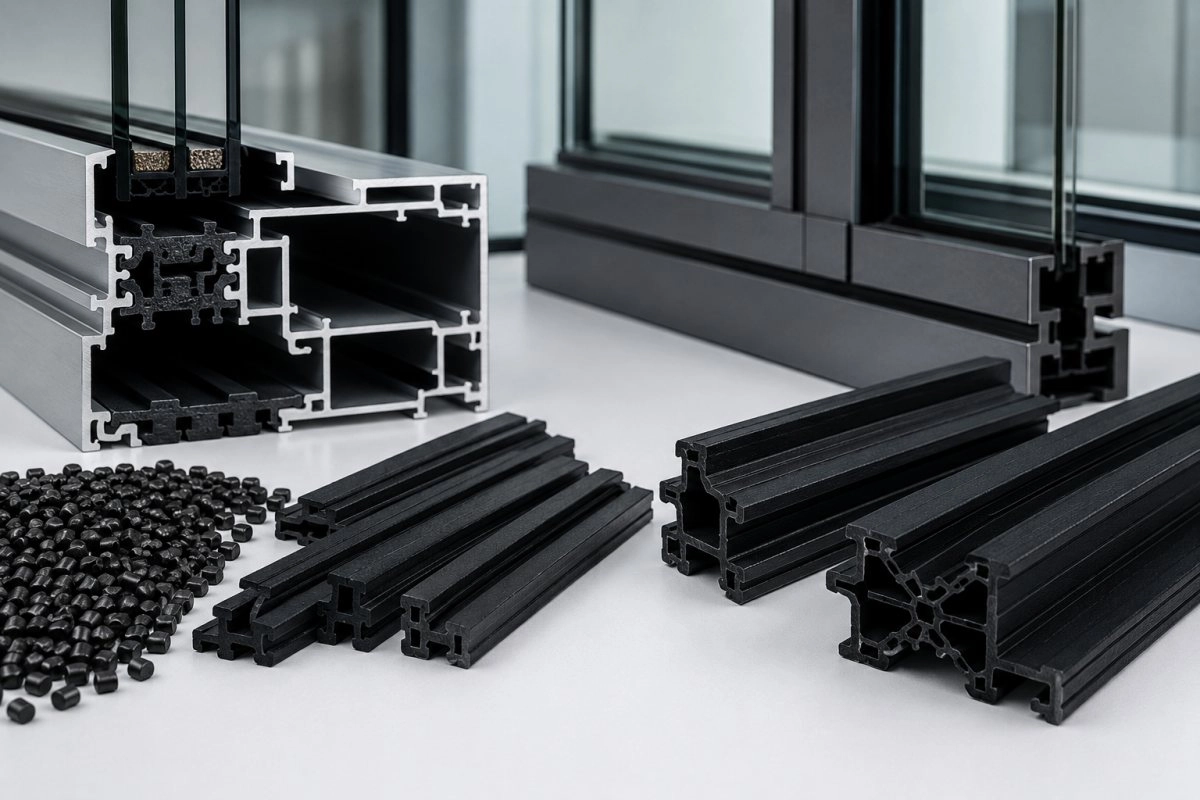
High-performance thermal barrier strips made from reinforced PA66 polyamide provide not only thermal insulation but also structural stability and long service life. In modern aluminum building systems, the quality of the thermal break directly influences energy efficiency, condensation control, occupant comfort, and facade durability.
For building professionals and procurement teams, careful evaluation of these factors helps ensure that the selected thermal barrier strip delivers reliable performance throughout the life of the building.